
The answer can make or break your cost stability, operational intensity, and resilience.
Let’s unpack why.
Single‑Use Packaging Has Become Financially Fragile
In many companies, packaging has quietly evolved into one of the most unstable elements of COGS and operational cost. As a result, the traditional single‑use packaging model is exposed on all sides:
- Raw material price volatility
- No cost predictability beyond short‑term contracts
- Direct exposure to regulatory change and EPR fee escalation
- No balance‑sheet value
Every shipment becomes a new procurement event and therefore becomes a cost risk is passed directly to operations.
This model worked when materials were cheap, regulation light, and supply abundant, nevertheless, those conditions no longer exist.
How Reusable Packaging Mitigates Volatility and Operational Intensity ?
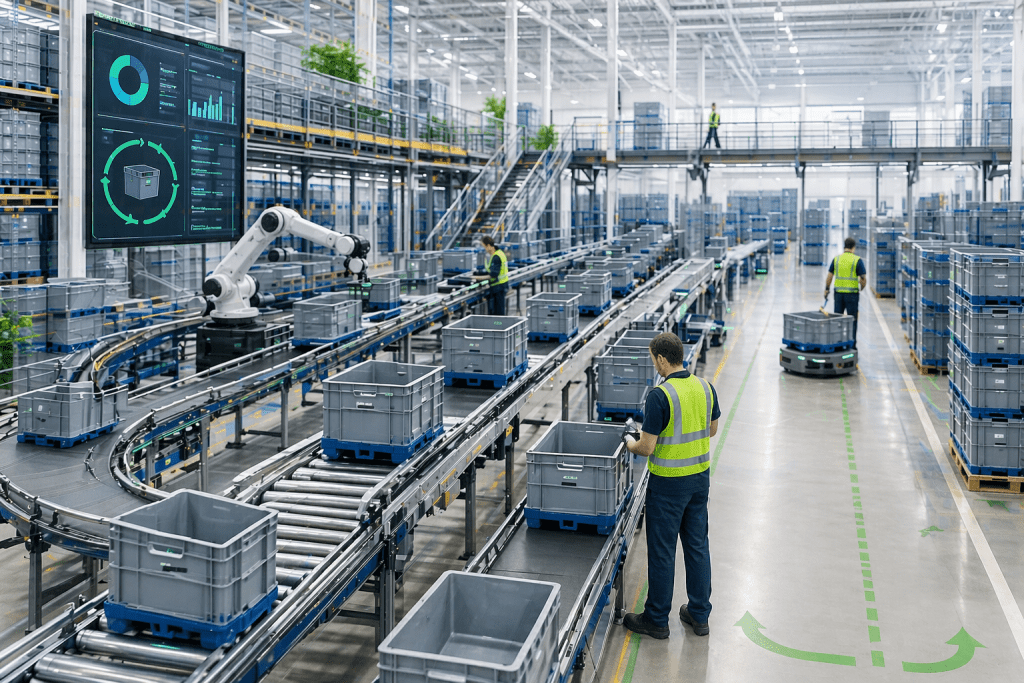
The shift to reusable packaging is not a tactical improvement. It has become a strategic move from expense to infrastructure.
Reusable packaging fundamentally changes both the financial and operational logic of packaging.
Here is how:
1. Cost Stability Through Infrastructure
Reusable packaging creates stability by design.
It is:
- Insulated from day‑to‑day raw material price fluctuations
- Less dependent on continuous supplier renegotiation
- Designed for predictable total cost of ownership (TCO)
Multiple industry studies indicate that cost neutrality or net savings are typically achieved after 10–25 cycles, depending on the application, transport loops, and recovery rates (Ellen MacArthur Foundation, 2024).
Once deployed at scale, packaging cost becomes structural rather than transactional.
2. A Depreciable Asset. Not a Consumable
Unlike single‑use packaging, reusable packaging has the following advantages:
- Can be capitalized in most cases
- Is depreciated over several years
- Can be tracked, maintained, and optimized
For finance teams, this represents a critical shift: from more volatile operating expense (OPEX) to stable capital expenditure (CAPEX). Consequently, in a period of sustained margin pressure, this distinction matters more than ever.
3. Reuse Forces Packaging Minimization
One of the most underestimated benefits of reusability is design discipline.
When packaging must return, withstand repeated handling and integrate into standardized logistics systems, organizations are compelled to rethink what is truly necessary.
As a result, companies naturally:
- Reduce unnecessary material
- Eliminate over‑engineering
- Align packaging size with real product and transport needs
This commonly leads to 10–30% material reduction, even before reuse cycles are accounted for (McKinsey Packaging Insights, 2024). Once implemented, at least of 95% of packaging material use reduction occures during the use over the full reuse pool life time. (Circl’it).
The Strategic Shift: Packaging as a System, not a SKU
The companies moving fastest are no longer asking: “How much does this box cost?”
They are asking:
- How stable is this packaging cost over the next five years?
- How much can we control internally?
- Does it support productivity and standardization?
- Does it improve operational resilience?
Reusable packaging does not eliminate cost but it makes cost predictable, accountable, and optimizable.
In an era of volatility, the most competitive packaging strategy is not cheaper packaging but controlled packaging infrastructure.