Seeking to reduce waste in your food & drink service?
Single-use packaging creates waste and represents avoidable costs for events, shopping malls, cities, restaurants and cafés.
Discover how reusable packaging systems support fast service, customer convenience, efficient returns, and scalable waste reduction, from daily food service to city-wide reuse schemes and high-intensity events.
Reusable solutions for packaging waste reduction in food & drink service

Reusable food containers & cups
Durable, food-grade containers designed for repeated use in take-away, dine-in, and event service. Optimised for fast handling and customer convenience while replacing disposable food packaging.
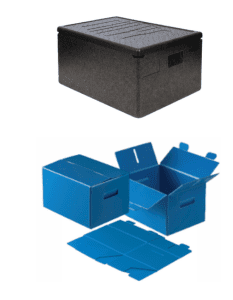
Durable crates and boxes
Food contact approved and cold chain solutions for food distribution, central production sites, canteens, and event logistics.
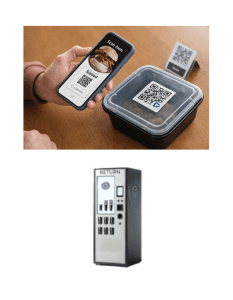
Smart collection and tracing systems
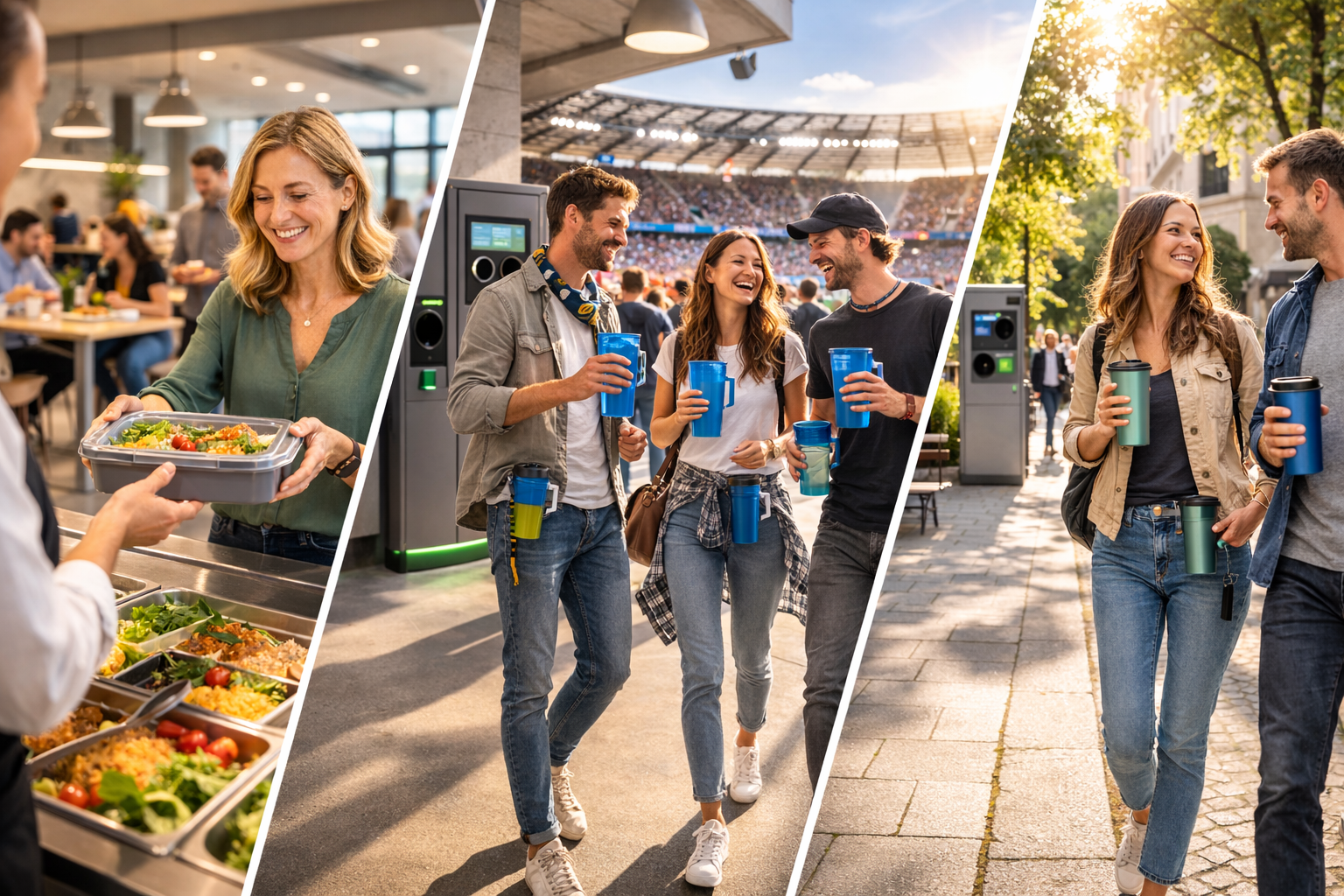
Making returns effective, including both - deposit returns or deposit free solutions. Suitable for events or any highly frequented sites with concentrated take away options. Work with multiple items. Different solutions suitable for different end use applications.

Waste-free events and foods service operations
Innovate customer experience
Case Study: A distributor with regular logistics reduces packaging costs by 40–70% by switching to reusable packaging alternative.
Stop the waste
Case Study: A manufacturer secures new business in a global healthcare tender thanks to its sustainable packaging credentials.
Position for the long term
Case Study: An e-shop cuts CO₂e emissions from packaging by 87% by replacing cartons with durable reusable boxes.
USE CASE
Zero-waste
shopping mall
One system, many tenants
A zero-waste shopping mall treats packaging as shared infrastructure.
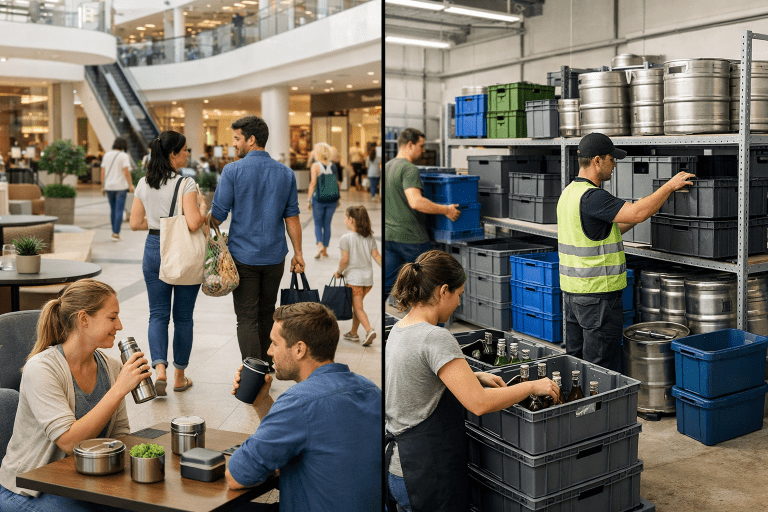
Reusable food crates, cups, containers, and bags are provided at mall level and used by all tenants.
This is a strategic move introducing packaging as service model that facilitates waste reduction, creates shared infrastructure and simplifies daily operations, which allows each brand to focus on service and sales.
Food, drinks, cinema and retail with zero waste
- Food courts use reusable crates for ingredients and meals.
- Refreshment points use reusable cups for coffee and soft drinks.
- Retail use returnable bags.
One return system across food, entertainment, and shops, reducing waste peaks, improving cleanliness and preventing overflowing waste bins.
Suppliers as a strategic framework
Zero waste works only if suppliers follow the same rules.
The mall sets a supplier framework defining reusable crates, delivery standards, hygiene, and return flows.
Food and drink suppliers plug into one system, reducing exceptions, improving reliability, and making zero waste part of standard procurement, not an add-on.
Business value at the core
- Group purchasing lowers packaging costs.
- Waste management fees drop.
- Cleaner operations improve efficiency.
- Reusable systems attract customers and enable gamification and loyalty.
Zero waste approach becomes a scalable business model, embedded in tenant rules, supplier standards, and everyday mall decisions.
Find out if reusable packaging fits your operations
Meet the innovators of food packaging
🚚 Logistics Company Cuts Costs & Eliminates Waste with Reusable Transport Boxes
Implementing reusable transport and storage packaging options is a quick win for logistics providers as well as their customers seeking to decrease costs of packaging disposal and gain measurable sustainability credentials.

🛍️ E-Shop Slashes CO₂e Emissions by 87% with Reusable Packaging
An e-commerce retailer, shipping thousands of small packages per month, managed to replace single use paper and plastic packaging reducing waste and engaging customers.

🌍 Global Manufacturer Wins Healthcare Tender with Sustainable Packaging Edge
Sustainability credentials make up an integral part of qualification criteria in the healthcare sector. Public sustainability commitment, clear plan of action and measurable outcomes make a difference.
Expert support at your side
We operate across Europe and are ready to assist local and pan-European projects.
Check what’s your opportunity
Book a Meeting
Go ahead and schedule an unbinding introductory meeting at your convenience HERE.
Get in touch
Looking for more information? Tell us about your project and we’ll get back to you withing 48 hours.
Get a free expert assessment of the opportunity
Frequently Asked Questions
Reusable packaging in HoReCa operations and service
How does reusable packaging work in HoReCa environments?
Reusable packaging in HoReCa operates through both closed-loop and open-loop systems, depending on the situation service model.
In practice:
- Closed-loop systems work for canteens and events with controlled returns for packaging assets that in principle do not change ownership
- Open-loop systems for city-wide take-away with multiple return points where ownership might be handed over to consumers, service operators and especially where reuse and return infrastructure is shared among many stakeholders
- Packaging circulates between service points, customers, return points, cleaning facilities, and logistics hubs
- Tracking, deposits, or pooling with transport ensure availability and control
Do HoReCa operators need reusable packaging to comply with regulation?
Yes. Under the EU Packaging and Packaging Waste Regulation (PPWR), HoReCa operators face binding reuse obligations that apply to takeaway, on‑premise consumption, beverage service, and event catering.
By February 2028, all takeaway food and drink must be offered in reusable packaging systems.
By 2030, at least 10% of takeaway items must be sold in reusable packaging.
By 2030, several single-use plastic packaging formats commonly used in HoReCa will be banned, including on‑premise food service packaging and condiment portions.
Beverage packaging must meet 10% reusable share by 2030, rising to 40% by 2040.
Closed-loop canteens, corporate restaurants, and controlled events are well positioned for early adoption, while city‑level reuse infrastructure will enable scaling across multiple operators.
How does reusable packaging reduce costs in HoReCa?
Cost reduction comes from replacing disposable packaging with durable assets.
Key drivers:
- Lower spend on single-use food containers and cups
- Scaled service and clean-up
- Consolidated and integrated collection and service networks
Is reusable packaging more complex for staff and customers?
No. When designed properly, complexity decreases.
- Reusable packaging should be carefully selected for the concrete purpose and operations
- Appropriate technology and collection system must be selected for efficiency and customer convenience.
- Partnerships on the entire reuse systems must be established to optimize resources.
Then staff and customers benefit from clear, repeatable routines.
This is where our expert guidance becomes useful due to our complete knowledge of the market solutions as we save time and prevent unnecessary mistakes in implementation.
Does implementing reusable packaging slow down service?
No, if the systems are designed with the right reusable packaging items integrated with the collection points and services that are required for the use case. This is where our expert assistance, thanks to knowledge of the market solutions and ability to form partnerships, saves time and prevents unnecessary mistakes in implementation.
Is reusable packaging suitable for one-time events?
Yes. Events are ideal for reuse because:
- Flows are concentrated
- Return rates are high
- Collection technology exists
- Preventable waste management costs are significant
Closed-loop event systems deliver immediate waste and cost reduction.
When is reusable packaging not the right solution?
Reusable packaging may not be suitable when:
- Volumes are extremely low
- Service is irregular without return options
- Infrastructure for cleaning or returns is unavailable
In these cases, our recommendation focuses on optimization, incl. right-sizing and recyclable alternatives.