
Reusable packaging is often presented as a simple swap: replace single-use with reusable alternatives and sustainability follows. Yet, in reality, reusable packaging cannot function in isolation. Without the right systems behind it, even the strongest reusable asset quickly becomes waste.
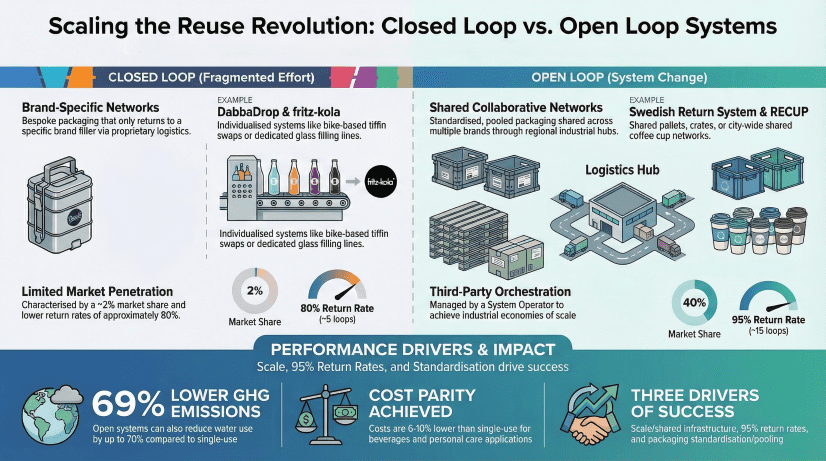
At the heart of every successful reuse model is infrastructure and, more specifically, how reusable assets circulate. Broadly speaking, there are two principal models of circulation: closed loop systems and open loop systems. While both aim to extend packaging life and reduce waste, they operate very differently and serve different use cases.
Closed Loop Reuse Systems
In a closed loop system, reusable packaging stays within a clearly defined environment.
This may include:
- A single company campus
- A dedicated distribution or logistics network
- Inter-company supply chains
- Controlled-use spaces such as company canteens, festivals, or events
Key Characteristics
- Defined circulation
Packaging moves within a limited, known system. This means that assets are issued, returned, and reused within the same organisational or logistical boundaries. - Asset management is essential
Even in a restricted environment, reusable packaging must be tracked and actively managed. Without visibility and accountability, loss rates increase rapidly and reuse breaks down. - Supporting infrastructure is non-negotiable
Closed loop systems still require:- Reverse logistics
- Collection points
- Cleaning and servicing
- Basic tracking or inventory management
When Does a Closed Loop Work Best?
Closed loop reuse is particularly effective when:
- The distribution network is stable and predictable
- The number of users is limited and identifiable
- Return behaviour can be controlled through internal policies
Typical examples include reusable transport packaging in logistics, returnable containers between manufacturing sites, or food containers used within corporate campuses.
Financial Considerations
One of the key advantages of closed loop systems is speed to return on investment. Because losses are lower and circulation is tightly controlled, systems often reach financial break-even within one to two years, sometimes even faster. This makes closed loops an attractive entry point for organisations starting with reuse.
Open Loop Reuse Systems
Open loop systems take reuse a step further and therefore make it more complex.
In an open loop model, packaging moves across broader networks, often:
- Across cities or regions
- Between multiple brands
- Through many return locations
This is where reuse has the potential to scale system-wide, but only if the right conditions are in place.
Key Characteristics
- Flexible return options
Consumers can return packaging to multiple locations, not necessarily where it was originally obtained. Convenience is critical—without it, return rates fall sharply. - Shared infrastructure
Unlike closed loops, open loop systems rely on shared, cross-brand infrastructure that includes:- Collection and return points
- Centralised sorting
- Cleaning and repair facilities
- Tracking technology
- Incentive or deposit schemes
- Standardisation and pooling
Packaging works best when it is standardised and pooled, therefore allowing items to circulate freely across brands and locations. Custom or proprietary formats dramatically reduce efficiency and increase costs.
Where Do Open Loop Systems Apply?
Open loop reuse models are typically seen in:
- Reusable takeaway cups in urban café networks
- Food delivery containers
- B2C e-commerce packaging
- City-wide returnable packaging schemes
These applications offer significant environmental upside but only with high participation and system reliability.
Behaviour and Incentives Matter
Open loop systems depend heavily on user behaviour. Clear incentives (such as deposits or rewards) and, in some cases, penalties are crucial to ensure returns. Convenience alone is rarely sufficient; behaviour must be actively designed into the system.
Choosing the Right Model and Making It Work
There is no universal “best” reuse system. The right model depends on:
- The complexity of the distribution network
- The level of control over users
- The desired scale
- Available investment in infrastructure
What both models share, however, is a common truth: reusable packaging is a system, not a product. Whether closed or open loop, reuse only delivers value when circulation, tracking, cleaning, and accountability are designed holistically from the start.
Without that foundation, reuse does not reduce waste, it merely delays it. It is therefore very important to bring in the right solutions and expertise as well as think about partnerships across supply chain or within a sector.